Argos, the algorithm and the Anthropocene: on grieving a burning world
There is little to celebrate in the summer of 2026, a summer in which we are all engaged in a seemingly endless and vain odyssey back to a ‘normality’ we refuse to accept is long gone.

I have a strange yet vivid memory of my childhood that involves being at the cinema. A very cool, art house-y cinema, as I recall, which also held workshops and screenings for children. I forget what the overall topic of the film was, but I think it was some kind of nature documentary about what were called, in those days and for my youthful demographic, ‘minibeasts’. There was a scene that involved snails, which was perhaps the reason my parents had taken me there in the first place, as I was an avid lover of snails as a child. My mum was once called into school by a teacher, who complained that I’d been putting them on my face during class (snail slime is now a renowned skincare fad and K-beauty secret, so clearly I was just a precocious dermatological entrepreneur at the tender age of seven, my talents unappreciated by the masses; missed my calling as a ‘skinfluencer’, clearly). I think the film may have shown the weirdly hypnotic mating ritual of snails, which involves two bodies twining around each other in a mucal embrace, rather like the way your arms and legs interlace if you’ve ever tried to do the eagle pose in yoga. Perhaps for this reason, I remember a group of boys in the seats behind me giggling uncontrollably. I started to cry.
It is hard to pinpoint exactly why I was crying, even now. I suppose if I had to articulate it, it would be something along the lines of: I was crying at the way in which these fascinating, magnificent and quietly dignified creatures had been reduced by those childish boys to something worthy of ridicule. Not just that, but in their laughter I heard echoes of every crunch there ever was of a snail trodden into a pavement, whether deliberately or by accident, and by extension every animal destroyed for being a mere inconvenience to our ever growing anthropocentrism. I cried for the snails, but not just for the snails: for the selfishness and blindness of humanity in ridiculing and destroying what it cannot understand. I felt the lost battle fought by those snails and their tiny counterparts, trying to exist in a world that increasingly pays no attention. It was as if I heard their cries for help, and was powerless to provide any. My heart ached for all the minibeasts, quietly going about their business in a world so saturated with risk from our careless, giant human existence. It set the scene, unfortunately, for a lifetime of such feelings.
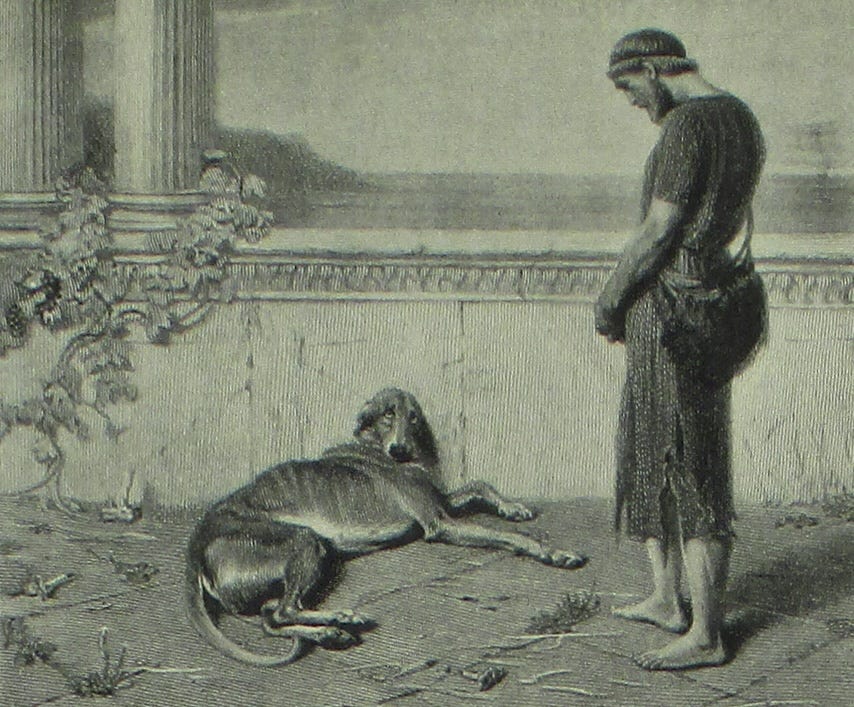
Fast forward thirty years or so, and I’m quietly weeping again in the cinema. This time it’s Christopher Nolan’s The Odyssey, and there’s not a snail in sight. The tears started at the moment Penelope’s suitors started kicking Odysseus’s faithful old dog, Argos, eventually throwing him outside onto a dung heap where he lies, paralysed and pitiful. They continued as Odysseus and his men invaded the home of the solitary Cyclops, their actions quickly moving from self-defence to arrogant violence (I’m not alone in lamenting this one, apparently — my instagram is full of memes telling me that many others are feeling sorry for Polyphemus, who just wanted to be alone with his cheese). Then, as the suitors abused Odysseus’ loyal servant Eumaeus, forced to burn the bodies of his beloved hunting dogs after they are massacred. By the time Odysseus was reunited with Argos, laying a tender hand atop the head of his loyal four-legged friend, I’d given up on all pretence and was quietly letting my shirt become damp around the collarbone. As the credits rolled, I asked myself what exactly I was crying for. Weeks later, I’m still asking.
I can’t say I particularly enjoyed The Odyssey. I found it unequivocally bleak. To me, that image of poor Argos, abandoned to die on a dungheap, whining piteously, contains the whole of the film in microcosm. To me, the abiding, overwhelming theme of Nolan’s masterpiece is human cruelty. The senselessness of it, the colossal weight of it, the insidious contagion of it. (There’s another essay in here somewhere about how the bulk of that cruelty is perpetuated by men, but that’s for another time; I bet Odysseus’s men would also have laughed at mating snails). It’s a film that seems to hold its hands up in despair. Look, it seems to say; look at what we do; what we’ve always done. Look at how we just can’t seem to turn away from the impulse to cause pain and suffering. Look at how we will end ourselves, given time. The ‘people from the sea’ revelation is just the ending of Planet of the Apes in another guise. Plot twist: it’s us; we caused our own downfall. We always will.
This shouldn’t necessarily be surprising. ‘Sword and sandals’ epics, as they’re often called (think Spartacus, Gladiator, Troy, and now The Odyssey), have much in common with medievalism: contemporary re-imaginings of the medieval period in literature, film, TV, and other media. In his book, Medievalism, David Matthews notes how modern re-imaginings of the medieval often make use of an important binary: the romantic medieval versus the barbaric medieval. The former is the kind of medievalism we find in Disney movies like Sleeping Beauty and The Sword in the Stone: all gallantry, chivalry and happy-ever-after romance. It’s designed to make us look back wistfully on a supposedly more heroic golden age of human civilization. The polar opposite, the barbaric medieval, is designed to make us breathe a sigh of relief that we live in much more ‘civilized’ times. It’s a medieval of graphic, grotesque violence and torture, and gratuitous rape and misogynist abuse. It’s the medieval we find in abundance in Game of Thrones and Vikings, not to mention the legendary comment in Pulp Fiction about ‘getting medieval’.
Nolan’s Odyssey is interesting because it manages to completely skewer the fantasy of ancient Greece as a world of gods, magic, heroism and near-impossible feats endured in the name of romantic love (twenty years! He spent twenty years doing everything to get back to his wife! Walking green flag!!!), without completely leaning into the kind of barbarism we witness in, for example, Game of Thrones. Sexual violence is notably absent (although implied during Odysseus’s conversation with Circe), a welcome reprieve for female consumers of visual media like myself who are heartily sick of rape constantly being used as a plot device. The violence isn’t particularly graphic or gory — it wouldn’t even register on the Game of Thrones barometer. And yet that is perhaps why Nolan’s film had such an effect on me. It didn’t need blood, guts or sexual violence to convey its nihilistic message. What stuck with me were the more mundane cruelties; the ones I couldn’t comfortably dismiss as belonging to the realm of sensationalist fantasy. The maligned old dog on its dung heap. The beggar, ridiculed and spat upon. Eumaeus, made palpably aware of his vulnerability in the face of those with greater wealth, bodily ability and therefore power. These are cruelties that belong not to the realm of gods and magic, but to contemporary life. They are cruelties we have probably all witnessed, if not directly experienced. Nolan’s film refuses to allow us a moment of respite — there are no CGI dragons or white walkers to coddle us back into the realm of reassuring, distant fantasy (and Nolan’s famous aversion to CGI and dedication to making special effects as ‘real’ as possible no doubt contributes to this). Instead, we are forced to spend three hours looking into a mirror at the very worst, and, the film suggests, inevitable, tendencies of our human selves. If that doesn’t leave you wanting to cry, you’re a stronger spectator than I am.
I think the reason it hit me so hard at this particular moment is because, in this relentless summer of broken records, drownings and wildfires, I’m all too aware of humanity’s capacity to ruin everything. I think often of the ending of Netflix’s satirical 2021 film Don’t Look Up, where Leonardo DiCaprio’s character murmurs, wistfully, ‘We really did have it all, didn’t we?’, as the meteor everyone knew about but refused to do anything about careens inevitably towards Earth.
We did have it all, didn’t we?
We have less, now.
Feelings of disquiet seem all the more jarring in the harsh light of day — and it is, this summer, harsh indeed. Literature has taught me that the appropriate setting for grief and despair is a manor house on the Yorkshire moors, or a dreary night of November in Ingolstadt. It seems wrong, somehow, to be able to tan and feel existential despair at the same time. Yet, in 2026, summer is no longer picnics and strawberries, but death. Canned G&Ts in the park with a side of heatstroke. Floral sundresses accessorised with a hosepipe ban and crisping foliage. Paddling at the seaside while, in a nearby waterway, some young man inhales lungfuls of water and pays the ultimate price for his attempt to cool off. Draping yourself in a chic electric neck fan, while the sick and elderly take their last breaths in hospitals without air conditioning. Enjoying a bowl of surprisingly early blackberries and plums, while farmers’ livelihoods shrivel and die on the vine. I remember when my SAD-prone self used to herald the arrival of summer like a freediver gulping down oxygen upon surfacing. She would head south for an even greater dose of warmth and vitamin D. She would sunbathe, a concept that now seems as unthinkable as smoking. The sun, in the Anthropocene, is an oppressor; no longer celebrated, but feared. I treat it like a home invader, spending heatwaves prostrate in the dark with all the blinds closed, hoping that if I stay still and silent enough, it will depart in peace.
In this charged, stifling atmosphere, the cruelty, stupidity and arrogance of mankind seems somehow multiplied. The murderous summer sun — a sun we have failed to properly respect, understand, and protect ourselves against — throws the collective failings of humanity into sharp relief; nowhere to hide, no shades of nuance. There is little to celebrate in the summer of 2026, a summer in which we are all engaged in a seemingly endless and vain odyssey back to a ‘normality’ we refuse to accept is long gone.
My social media algorithm seems to have sensed the mood, read the room. Daily, it serves me up a delightful smorgasbord of animal cruelty and death to garnish my abiding memories of Argos on the dungheap. I cannot open Facebook without being treated to images of bloodied cats at the side of roads. At first it made some kind of sense — they were in my local neighbourhood Facebook group, and people were trying to identify the owner — but then I started seeing posts from other counties, and then other countries entirely. Pretty soon it wasn’t just cats hit by cars, but posts about horrific things human beings had done to cats (some of which are probably the cause of aforementioned wildfires, but I won’t go into detail. If you know, you — very unfortunately — know.) Then it wasn’t just cats, but snakes too. Today, it’s crabs. I deleted Facebook and Reddit from my phone weeks ago, having found I couldn’t even visit the aquarium- or cat-owning communities any more without being exposed to a plethora of stories of cruelty and neglect. I thought I’d be safe on instagram — the home of glossy influencers and tradwives serving up confectionery — but it turns out, I’m not. There are no trigger warnings, no time to brace myself for relentless tales of cruelty and suffering, popping up in between the patisserie. Social media is no longer a safe(ish) space, a fluffy bubble of cute cat videos and harmless bakery content. Even the cute videos have me wondering whether animals have been the victims of cruelty, forced into charming outfits or amusing positions. When well-meaning friends send me videos of ‘cool’ aquarium content, all I see is overstocked tanks featuring artificially dyed glowfish, or suffering, stressed fish whose behaviour has been repackaged as laughter bait.
I never thought I’d cling desperately to AI as a kind of lifeline, but in such times all I can do is tell myself ‘it’s not real, it’s not real’, like the repeated mantra of a quaking child self-soothing after a bad nightmare.
I feel like I am in a double-walled prison. Trapped in my home by the ferocious urban heat island of the Belgian suburbs, I’m cloistered, too, in a digital cell whose walls whisper to me of the myriad ways in which humanity inflicts and afflicts. Fantasies about fleeing it all to live off-grid on a tiny island or a cabin in the woods are futile. As Nolan’s Odyssey makes clear, the worst of humanity will still find us. There’s a sword-shaped hole in Polyphemus’s solitary cheese-making plans. A troupe of greedy would-be rapists at Circe’s front door. A grocery bag in the Mariana Trench and nanoplastics on Mount Everest.
This mood extends beyond social media, too; beyond the two-dimensional images of dead cats and injured snakes. A curled-up dead mouse I spied on the pavement on my bike ride to work yesterday seemed to proclaim the insurmountable hostility of the world humanity has created. I find myself feeling pain for everyone and everything, even those that probably don’t need or want my sympathy. An obese, balding woman, moving ponderously around at the supermarket. I immediately construct a narrative of her intense loneliness and misery and start to cry, but it also occurs to me that this is entirely unfounded. She may have a thriving polyamorous sex life and a selection of highly fulfilling hobbies. The man at the flower stall in the city with no customers when I walk past, whose selection of beautiful bouquets seem to have been prepared with such care. How devastating, I think to myself; he’s put all that effort in, and yet no one wants one. Do I know that, though? My only evidence is the lack of customers in the thirty seconds when I walk past. Every shop closure whispers to me of livelihoods gone up in smoke; dreams ruined by extortionate rents and the relentless march of Amazon and Temu. An elderly man walking his equally elderly dog brings me to tears. I narrativise compulsively, aware that I am projecting, and yet still my overriding feeling is one of deep, hopeless grief.
I sometimes feel like I’m part of some giant mycorrhizal network of suffering, unwillingly tapped into the stricken elegies of a dying planet. Like a tree, my veins snake deep into the earth, where they pulse and shudder with the vibrations of our collective miseries. I walk down the street and I want to weep for the exhausted bees, the parched vegetation, the overheating earth we continue to ignore even though it is screaming and swallowing us whole. Even the sight of living animals, caught up in the relentless need to survive, makes me ache to my bones with my impotence, my inability to help in any way at all. My heart breaks for crushed bugs on the pavement, stray cats and dogs, even a pollen-laden bee, whose fate is inevitably to succumb slowly to pesticide poisoning. I sometimes feel like the world is screaming in agony, and a part of me is screaming too. Unable to get out, it quietly festers, leaving me blackened and burned inside like the remnants of a Mediterranean wildfire. A cynic. A sceptic. A Circe.
There are various labels out there — Highly Sensitive Person (HSP), empath, neurodivergent — but I think of it more like being a sponge. A walking, talking, exhausted sponge who absorbs every emotion from her surroundings, whether she likes it or not. The result is to be permanently bowed, hunched under the weight of far too much empathy. Inexplicably grieving for a pair of snails on a screen.
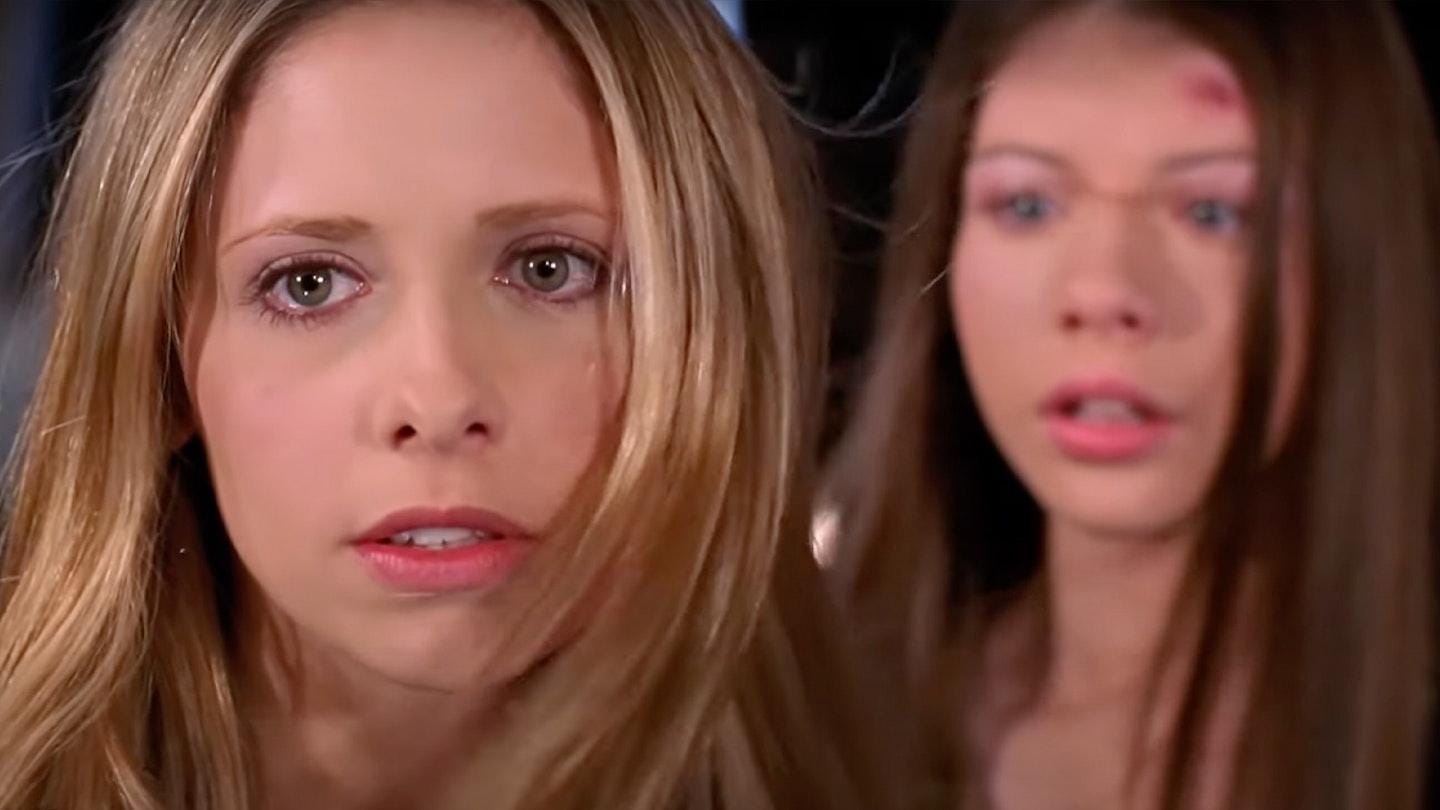
For analogies I turn, as I so often do, to Buffy the Vampire Slayer. Two episodes, specifically. In ‘Earshot’, in season three, Buffy is accidentally imbued with part of a demon she killed, enabling her to hear the thoughts of everyone around her. At first it’s amusing: she can steal the correct answers in class by listening in to better students, or laugh at the pathetic one-track-mind of high school boys. Soon, though, it becomes a curse: overwhelmed by her new direct line to the innermost thoughts and feelings of the Sunnydale masses, Buffy is seen thrashing around in her bed in a foetal position, feverish and whimpering. ‘If it doesn’t stop soon, she’ll go insane,’ Giles warns, recalling the case of a man who met the same fate and was forced to live in total isolation from humankind. At the finale of season six, Dark Willow, turned evil by grief and vengeance after the death of her lover, Tara, saps Giles of the magic powers with which he was imbued by an English coven. Thinking it will strengthen her, Willow is horrified to find that the magic instead causes a kind of heightened empathy. It forces her to tap into the pain and sorrow of everyone around her, as she becomes a conduit for the world’s grief. Unable to bear it, her response is to try to end the world by dredging up an old Satantic temple and performing a ritual.
Now, I’m obviously not saying that I’m planning to raise a Satanic temple from the ground and end humanity’s suffering. (Maybe I’m not not saying that?) At such times, my Dark Willow-adjacent response is simply to take a kind of nihilistic, resentful, gleeful comfort in the fact that I do not have children. I’ve beat your system, I want to scream at humanity. It’s a trap, any fool can see that. You won’t catch me manacling myself to this hellscape with my fallopian tubes. This circus of self-sabotage is overstaffed already. End it, I find myself silently taunting the world. End it all; burn us to a crisp, see if I care. We deserve it. I’ve got no skin in this game. My cats will be gone before me, and then I will sink deep, deep into the earth, hoping that my crumbling bones, mired in peat and humus and clay, will speak a language it can understand. And I — what is left of me — will simply say: I failed you. I am sorry.
As the nihilistic glee fades into hopeless grief, I think again of Buffy. Preparing to sacrifice herself to save the world by jumping into a portal of pure energy that has split temporal dimensions apart and unleashed chaos, Buffy tells her sister Dawn at the end of season five that ‘the hardest thing in this world is to live in it’. ‘This world’, the world of Buffy the Vampire Slayer, is a low-fantasy realm of high school crushes and teenage heartbreak, demons and malevolent supernatural forces. The Slayer must guard and protect the Hellmouth to prevent the inevitable apocalypse that would ensue, should such forces escape en masse. But in this world, the one in which we now reside, the Anthropocene, the demons are of our own making. Call them what you like: people from the sea; climate-change deniers; animal abusers; Big Oil; the Far Right; Elon Musk; the genocidal; warmongerers; Donald Trump; data centres. We opened the Hellmouth, and there’s no Slayer who can conveniently sacrifice herself and slam it shut again. Instead, we sacrifice ourselves every day on the altar of the Anthropocene, our hope and our water supplies ebbing away, our bodies slowly choked by grief and microplastics. All we can do is live in it. And Buffy was right: it is really goddamn hard.